
Green Paper on the future of Geographical Indications

Presented during the VII Qualivita Forum – Siena, December 5, 2025

The Green Paper on the future of Geographical Indications, presented at the 7th European Forum on Food Quality in Siena, is a strategic policy document developed through the collaboration of the main international organisations of the GI system – oriGIn, oriGIn EU, Origin Italia, Origen España, oriGIn France and Qualifica-oriGIn Portugal – with the scientific and methodological contribution of the Fondazione Qualivita. Published only a few months after the entry into force of Regulation (EU) 2024/1143, it puts forward a shared vision for the implementation phase of the European reform, offering a unified interpretation of the challenges that the PDO and PGI systems will have to face in a rapidly changing global context: ecological transition, digitalisation, online protection, and the evolution of international markets.

Geographical Indications have established themselves in Europe as one of the most effective tools for rural development: they generate economic value, protect landscapes and traditional knowledge, and strengthen social cohesion and territorial identity. For this reason, today GIs must be fully integrated into the framework of the EU’s agricultural strategy and the revision of the CAP, not as an accessory measure but as a structural lever for competitiveness, sustainability and quality. Their nature as collective assets – built on shared rules, controls, transparency and a link to origin – makes them one of the EU’s most successful systems: capable of guiding supply chains towards more equitable and environmentally responsible practices, safeguarding agricultural biodiversity, improving the trade balance, and attracting investment, qualified employment and responsible tourism. This Green Paper aims to indicate the policy choices now needed to consolidate and expand this success: coherent integration of GIs into CAP instruments, strengthening the governance of Consortia and the competent public authorities of Member States, support for innovation and training, and protection in international markets. It is time to elevate GIs to a strategic infrastructure for the rural Europe we want: competitive, inclusive, and sustainable.

Vision and Actions: the future of Geographical Indications

Presented as a collective contribution from the production sector, the Green Paper marks a political milestone: it offers the European Union a platform for reflection on future quality policies and reaffirms the central role of GIs as a strategic infrastructure for the rural Europe we want – competitive, inclusive and sustainable.

From this stem clear operational choices: integration of GIs into CAP instruments, strengthening the governance of producer groups, support for innovation and training, and effective protection in international markets..
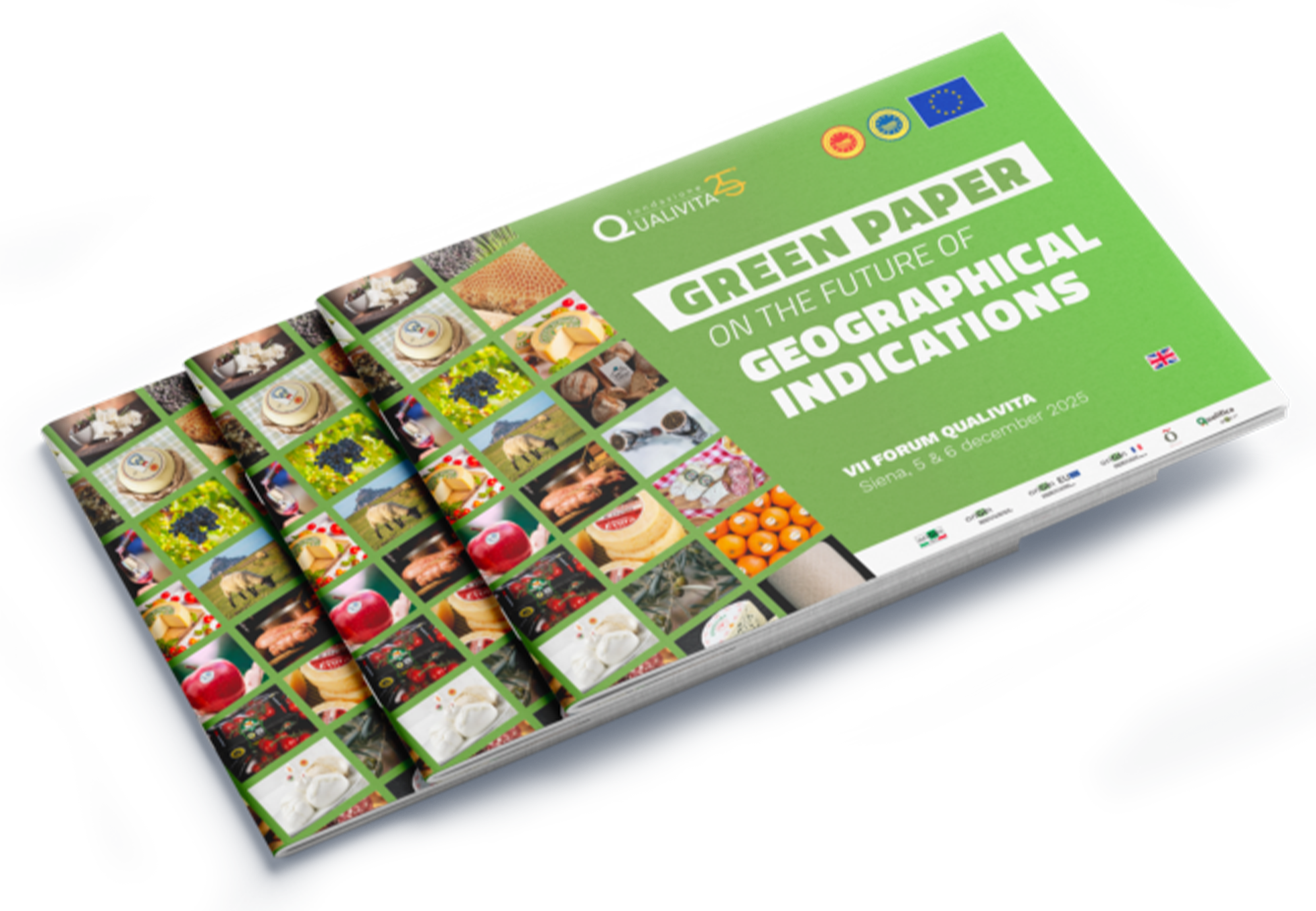
DOWNLOAD THE GREEN PAPER ON THE FUTURE OF GEOGRAPHICAL INDICATIONS

    Name (required)

    Surname (required)

    Organization (required)

    E-mail (required)

    Telephone number

    Informativa Privacy

    I have read the privacy policy and I give my consent to the processing of my personal data

    in collaboration with

    THE 8 THEMATIC FOCUSES OF THE GREEN PAPER

    1. Food geopolitics and food sovereignty: GIs as democratic infrastructures for the future

    Geopolitical conflicts, commercial instability, and the concentration of resources are redefining the global logic of food. In this context, Geographical Indications represent a network of territorial micro-sovereignties, capable of ensuring productive diversification and the safeguarding of local resources. GIs can become fundamental tools in the construction of a new European model of food security and justice. As democratic and participatory models, European GIs play a central role in supporting marginal areas and underdeveloped territories — helping to counter internal economic and social inequalities within the Union.

    Guiding question
    How can we strengthen the role of GIs in building European food sovereignty based on territorial identities, biodiversity, and production autonomy?

    2. GIs and tariffs: resilience of typical supply chains in the global tariff conflict 

    In today’s scenario of resurgent protectionism and tariff conflicts between economic blocs, GI agri-food supply chains are increasingly under pressure. Customs barriers and regulatory uncertainties put exports, competitiveness, and production continuity at risk. However, GIs can become active agents of economic diplomacy, capable of resisting and negotiating even in times of commercial crisis.

    Guiding question
    What strategies can GIs adopt to face global tariff tensions while preserving the economic and symbolic value of their supply chains?

    3. GIs and migration flows: inclusion, labor, and new rural citizenships

    A large part of the agricultural workforce in GI sectors today consists of migrants, often invisible but essential. If well-managed, GIs can become tools of inclusion, training, and economic participation — enabling virtuous models of rural citizenship and social cohesion.

    Guiding question
    How can we measure and enhance the overall contribution of GIs? How can the presence of migrants in GI supply chains be turned into a resource for the economic, cultural, and social regeneration of territories?

    4. The economic value of GIs in the future: generative wealth and systemic strategy

    GIs generate value beyond mere turnover: they create jobs, territorial attractiveness, reputation, sustainability, and innovation. Today, an evolved vision of economic value is needed — one that accounts for their systemic and generative impact. Unlike short-term, high-margin business models, GIs generate long-term value through origin constraints, production rules, and strong ties to local areas. For this reason, competitive comparison should not be limited to annual performance, but also consider multi-year economic sustainability, as shown by indicators comparable to Net Present Value (NPV) in the medium to long term. Now is the time to reformulate indicators, metrics, and strategies to recognize their full potential.

    Guiding question
    How can we measure and enhance the overall contribution of GIs to the real economy, including social, environmental, and cultural dimensions?

    5. Urban regeneration: the return of GIs to the cities

    Cities are rediscovering local food as a lever for urban regeneration, social inclusion, and sustainability. GIs can help redesign markets, public gardens, taste laboratories, and new proximity economies — bringing food culture back to everyday urban life.

    Guiding question
    How can GIs be central to new sustainable urban models, contributing to the ecological and social transition of cities?

    6. Youth, new consumption habits, and food citizenship: GIs in the horizon of new generations

    New generations — youth up to 25 years old — seek meaning, value coherence, and identity in food. GIs can speak the language of young people, but must renew their narratives, educational tools, and engagement methods to become cultural and political references for how young people live in the world. A strategy is also needed to encourage younger generations to take up GI-related professions, not only in agriculture, but also in processing, communication, and product protection — valuing traditional skills as levers for future employment.

    Guiding question
    How can we build a new cultural pact between GIs and young people that combines conscious consumption, sustainability, and participation?

    7. Artificial intelligence, digital life and GIs: new challenges for identity and food storytelling

    Artificial Intelligence is changing the way we know, choose, and tell the story of food. GIs must inhabit this new digital ecosystem without losing authenticity and meaning — becoming active protagonists in the construction of enhanced narratives, smart traceability, and ethical promotion tools.

    Guiding question
    How can we guide the intersection between GIs and Artificial Intelligence to strengthen knowledge transmission and the cultural identity of food?

    8. Cultural diplomacy and the narrative power of food: GIs as ambassadors of the territory

    Food is a universal language and a cultural heritage. GIs can act as soft power tools, representing European identity worldwide and promoting cohesion and intercultural dialogue. But narrative and institutional strategies are needed to support this role in a coherent and recognizable way.

    Guiding question
    How can we strengthen the role of GIs as cultural ambassadors of Europe in international, educational, and diplomatic contexts?

    VII European Forum on Food Quality

    The Green Paper was presented and delivered to institutional representatives at the 7th Forum on Food Quality, held in in Siena on December 5, 2025. The event, promoted by the Qualivita Foundation in collaboration with oriGIn, oriGIn EU, Origin Italia, oriGIn France, and Origen España, brought together experts, institutions, protection consortia, and key players in the quality agri-food sector at the Italian and European level.